
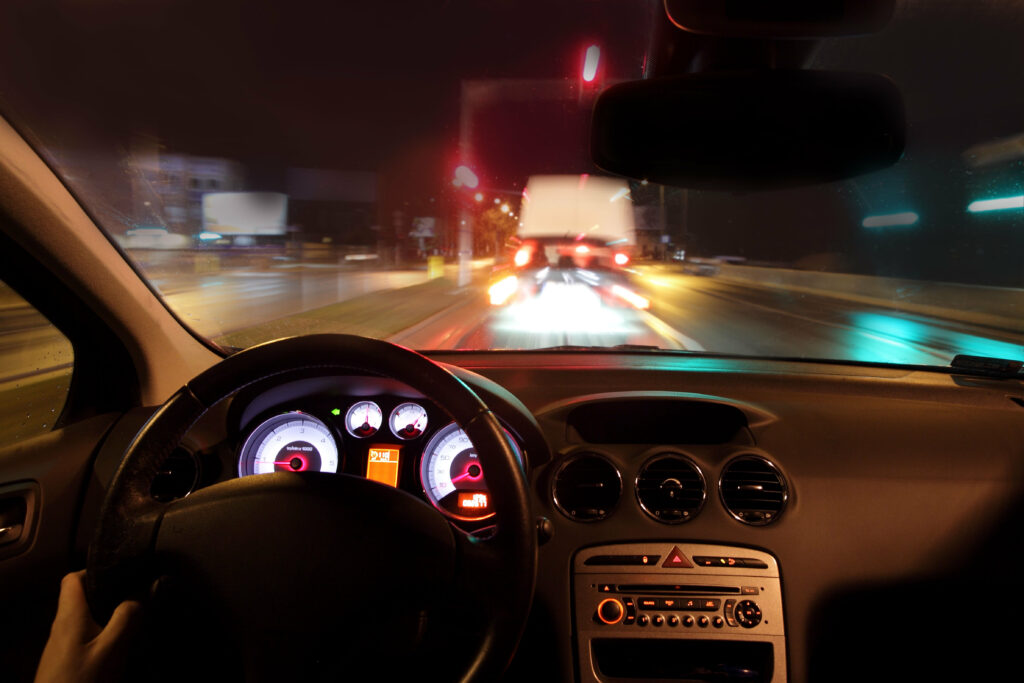
Night Blindness While Driving is a common vision problem that affects millions of drivers worldwide. Vision while driving at night must be sharp and reliable, yet many people struggle with poor nighttime visibility without realizing the underlying causes. However, for millions, driving at night can be challenging. Signs of night-driving vision problems may include headaches or halos around headlights, difficulty reading road signs, and visual discomfort. Many drivers experience these vision problems without realizing how they affect their night driving.
According to the National Highway Traffic Safety Administration (NHTSA), the fatality rate on our roads is much higher at night, despite fewer vehicles being on the road. A big portion of these types of incidents can be blamed on vision issues, namely, poor night vision. Poor nighttime visibility can make driving more dangerous and stressful.
What Is Night Blindness?
Night blindness, also known as nyctalopia, does not mean complete blindness at night. Night blindness is better described as a diminishing ability to see in the dark. A person may see clearly during the day but struggle to drive safely at night.
When dim-light vision is poorly developed, it can be traced to problems with specialized cells, such as rods in the retina. Night blindness is a symptom of an underlying issue that must be addressed; it is better described as a problem to be examined and is not a disease itself.
Typical Causes of Night Blindness in Drivers
1. Vitamin A Shortage
Vitamin A is crucial for the synthesis of rhodopsin, a pigment used by rod cells to detect light in dim conditions. Vitamin A insufficiency leads to a deficit in rhodopsin and, subsequently, poor night vision. Night blindness resulting from vitamin A deficiency is one of the most preventable issues around the globe.
Vitamin A deficiency is recognized by the World Health Organization (WHO) as one of the most common and correctable causes of vision loss. Individuals with diets that are low in dairy, eggs, leafy vegetables, and orange or yellow fruits and vegetables are the most susceptible to this deficiency. Making dietary changes to include vitamin A supplements will help with this issue.
2. Cataracts
With cataracts, the lens of the eye becomes smoky. A dimly-lit environment causes milling pupils. Drivers who have cataracts exhibit problems when confronted with bright lights. Age-related cataracts develop gradually and are extremely common in people over 60. Cataract surgery is one of the most successful procedures in modern medicine and typically restores clear vision, including at night.
3. Untreated/Delayed Myopia
Myopia or nearsightedness causes one to see distant images as blurry. During the nighttime, pupils tend to dilate more as a mechanism to pick up more light. An environment with dim lights, coupled with a dilated pupil, leads to optical problems with which most drivers experience night blindness.
4. Glaucoma
Glaucoma describes a group of conditions that damage the optic nerve. Slow dark adaptation and night blindness can be caused by the early stages of glaucoma. Glaucoma will also narrow and damage peripheral vision.
5. Retinitis Pigmentosa
Retinitis pigmentosa (RP) is the genetic degradation of the light-detecting rod photoreceptors. Night blindness is one of the earliest symptoms of the disease. RP causes the simultaneous degradation of peripheral vision and night blindness, making night driving extremely unsafe.
6. Diabetic Retinopathy
Uncontrolled diabetes causes the degradation of small blood vessels, including the vessels that make up the retina. Broken and degraded vessels disrupt the retina’s ability to process images. Night vision problems are one of the most noticeable early symptoms of Diabetic Retinopathy. Many diabetic drivers experience a gradual decline in night vision ability over a period of a few months to a few years.
When to See an Eye Doctor About Causes of Night Blindness
When getting an eye exam, consider whether you are having trouble reading street signs or road signs, are having halos, are having a delay in recovery from bright light, or generally have diminished ability to see at night.
Address your driving problems during the visit. How and when your vision problems arise helps your eye doctor diagnose your problems. These problems may not be detectable during the normal vision chart testing.
Conclusion
Night Blindness While Driving can make nighttime travel stressful and unsafe if left untreated. If nighttime driving feels difficult or stressful, an underlying vision problem may be affecting your eyesight. Each reason, be it a nutritional deficiency, loss of elasticity in your lens, or a genetic retinal disease, can be diagnosed and treated.
Night vision problems do not improve on their own. One vision test can help you drive at night with more safety and clarity. Take your nighttime driving problems seriously, and don’t wait for you and others to suffer the consequences of poor nighttime vision. Each time you drive at night, it negatively impacts you and your safety.