Urgent or more frequent eye exams should take place if you see one or more of the following warning signs:
◦ A normal baby should be able to look at your face and follow your eyes as you move from side to side.
2.Misalignment of the eyes
◦ As early as 2 to 3 months after birth a baby’s eyes should be aligned on interesting objects, near and far, left and right, and up and down.
◦ The eyes should rest steadily without jerking side to side or up and down.
◦ The pupil is the hole in the iris through which light enters the back of the eye and the retina. Under normal conditions, the pupil should be black.
5.Swelling around the eyelids
◦ Lumps, changes in color or swelling around the eyes and lids can be caused by tumors or infections.
◦ Serious inflammations, blurry vision and nerve problems are possible reasons for excess tearing.
◦ Abnormalities of the brain or tissue around the eye may cause one or both lids to droop or retract. Some children have drooping lid at birth, which may cause vision loss as well.
8.Squinting or frequent blinking
◦ Partially closed eyelids may produce temporary improvement or some types of blurry or double vision. Frequent blinking may occur with eye inflammation or allergies or with neurologic disorders.
◦ Pupil should be round and reactive to bright light. Irregular pupil can signal an eye problem.
.
What to Expect During Your Child’s Exam
◦ Visual acuity will be checked. This is possible even in children who are not old enough to speak. For older children, picture charts, letter games and letter recognition can be used.
2.Eye Alignment (Muscle Balance) Testing
◦ Various methods are used to test the alignment of the eyes and to make sure the muscles that move the eye are functioning normally. This may be done using light reflexes or alternately covering each eye to make sure that they do not move from the straight-ahead position.
3.Binocular Vision Testing
◦ These tests are used to make sure that the eyes are not only aligned correctly, but that the brain is using them together as well.
◦ Refraction is used to measure the “power” of the eye. It determines if your child is nearsighted, farsighted or has astigmatism. This can even be performed in infants when they cannot cooperate to tell us how well they are seeing. In young children, the focusing power of the eye must be eliminated to allow an accurate measurement. Therefore, drops are placed into the eye to dilate the pupil and eliminate their focus mechanism. These drops often take 30–60 minutes to work and do not wear off for 8–12 hours.
◦ During a fundus examination, the examiner uses a special light, often worn on his or her head, to look into the back of your child’s eye. The retinal blood vessels and the optic nerve, an extension of the brain, can be seen. Because this is an area where blood vessels and portions of the brain can be seen, it is very valuable in helping to diagnose many disorders that can affect the entire body. Once the examination is complete, your child may be prescribed glasses. Treatment for other problems may also be addressed.
.
Child Eye Safety
Each year, thousands of children have eye accidents at home, at play or in the car. These eye injuries can damage a child’s sight and even cause blindness. Parents are urged to acquaint themselves with potentially dangerous situations at home and in school and to insist that their children use protective eyewear when participating in sports or other activities.
To provide the safest environment for your children:
1.Select games and toys that are appropriate for your child’s age and responsibility level.
2.Provide adequate supervision and instruction when children are handling potentially dangerous items, such as pencils, scissors and utensils.
3.Be aware that even common household items such as paper clips, elastic cords, wire coat hangers, rubber bands, and fishhooks can cause serious eye injury.
4.Keep all chemicals and sprays out of reach of small children.
5.Do not allow children to ignite fireworks or stand near others who are doing so. All fireworks are potentially dangerous for children of any age.
6.Do not allow children in the yard while a lawnmower is being operated. Stones and debris thrown from moving blades can cause severe eye injuries.
7.Demonstrate the use of protective eyewear to children by always wearing protective eyewear yourself while using power tools, rotary mowers or lawn trimmers.
8.When participating in shop or some science labs, students should wear protective goggles that meet the American National Standards Institute (ANSI) Z87 safety code.
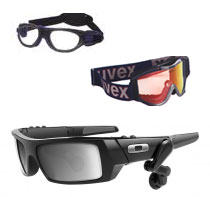
Eye Protection
According to Prevent Blindness America, more than 40,000 people each year are treated for eye injuries related to sports activities. For all age groups, sports-related eye injuries occur most frequently in baseball, basketball and racquet sports. Almost all sports-related eye injuries can be prevented. Whatever your game, whatever your age, you need to protect your eyes. While protective eye gear may not be the latest craze in tennis or baseball, think for a moment about what could happen if we fail to protect our eyes. We wear helmets to protect our head and pads or braces to protect our bones and joints. Extra precautions are taken to prevent concussions, broken bones, bruises and chipped teeth, so what about our eyes? What can we do to prevent the possibility of permanent vision loss, a scratched cornea or fractured eye socket? Broken bones and bruises will usually heal, but a serious eye injury can put you on the disabled list for life.
.
The following guidelines can help you find a pair of eye guards right for you:
1.If you wear prescription glasses, ask your eye doctor to fit you for prescription eye guards.
2.Buy eye guards at sports specialty stores or optical stores. At the sports store, ask for a sales representative who’s familiar with eye protectors to help you.
3.Don’t buy sports eye guards without lenses. Only “lensed” protectors are recommended for sports use. Make sure the lenses either stay in place or pop outward in the event of an accident. Lenses that pop in against your eyes can be very dangerous.
4.Fogging of the lenses can be a problem when you’re active. Some eye guards are available with anti-fog coating. Others have side vents for additional ventilation. Try on different types to determine which is most comfortable for you.
5.Check the packaging to see if the eye protector you select has been tested for sports use. Also check to see that the eye protector is made of polycarbonate material. Polycarbonate eye guards are the most impact-resistant.
6.Sports eye guards should be padded or cushioned along the brow and bridge of the nose. Padding will prevent the eye guards from cutting your skin.
7.Try on the eye protector to determine if it’s the right size. Adjust the strap and make sure it’s not too tight or too loose. If you purchased your eye guards at an optical store, an optical representative can help you adjust the eye protector for a comfortable fit.
8.Until you get used to wearing a pair of eye guards, it may feel strange, but stick with it! It’s a lot more comfortable than an eye injury.
.
