
Premium Lens Implants
Premium Lens Implants offer a new alternative for cataract patients seeking a broader range of vision than the vision provided by traditional “mono focal” lens implants. Recent technological breakthroughs have led to the development of several exciting new options for cataract patients, including theTecnis, Crystalens, ReSTOR and Acrilisa premium lens implants which can provide a broader range of vision, greatly reduce dependence on glasses and correct for presbyopia. These lenses are called “accommodating” or “multifocal” intraocular lenses because they allow the eye to accommodate a greater range of vision (from near to far vision) than the traditional “mono focal” implant, which typically can only correct for distance vision. In addition, the Acrysof Toric lens implant can help reduce or eliminate astigmatism after cataract surgery.



Multifocal Lenses – Acrilisa, ReSTOR, Tecnis
These are premium implants that can restore a range of vision with increased independence from glasses or contact lenses. For most patients these IOLs deliver excellent near and far vision and good intermediate vision without reading glasses or bifocals. In fact with this increase in vision quality, patients would be able to pass the visual acuity part of the driver’s license exam in most states (without glasses!). These lenses are unique technological innovation which is particularly well suited for patients who would like to have a chance of eliminating glasses. This lenses have been FDA-approved for cataracts, with or without presbyopia since March 2005 and was approved for use in Europe two years prior to that time.
How Does ReSTOR Work?
 ReSTOR Lens
As we perform daily activities such as reading, watching television or working on the computer, our eyes are constantly changing focus through a process known as “accommodation”. This task is performed by the lens of the eye, which changes shape, or accommodates, to allow the eye to focus at different distances. As we age, however, our lens loses the ability to change shape and thus our accommodating ability diminishes, causing us to become more dependent on bifocals or reading glasses. The Acrysof ReSTOR IOL is a foldable IOL lens that was designed to overcome this dependence, helping correct for the condition known as presbyopia. It features the latest of apodized and refractive technologies similarly used in microscopes and telescopes to improve image quality.
Typically there is an adjustment period for ReSTOR and all multifocal implant lenses, as a patient’s brain learns to see up close and at a distance. Also, as with all multifocal lenses, some patients report halos or glare around lights after their surgery. However, only 5% of patients receiving the ReSTOR implant had noticeable nighttime halos, and most of those reported decreased symptoms over time. Most patients reported that their ability to see at near, intermediate and far distances outweighed any visual side effects. The AcrSof ReSTOR lens comes from Alcon, a world leader for cataract surgery.
TECNIS
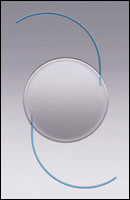 The TECNIS IOL is a multifocal IOL designed to give patients an increased range of vision. The TECNIS is the also recent innovation in lens implant technology and is the first IOL with a patented wave-front designed optic for recreating more youthful vision. It is specifically designed to provide safer, sharper vision at any distance and any light condition.
As we age, however, the eye’s spherical aberration (distortion) increases, reducing functional vision. Spherical aberration causes diffusion of light resulting in blurred vision, reduced contrast sensitivity and decreased function. The TECNIS IOL addresses this problem as it is designed to reduce spherical aberration.
How Does the TECNIS Lens Work?
The Tecnis Multifocal lens replaces the natural lens and is implanted into the eye during cataract surgery. It has a patented optic design that works like a bifocal lens inside the eye. For long-distance vision, the Tecnis multifocal lens creates a clear image of the far away object while at the same time a second, highly defocused image is created for near vision that is typically not perceived. For near vision, the Tecnis multifocal lens creates a clear, sharply focused near image and a second highly defocused far away image that is typically not perceived. This unique multifocal optic design gives it the ability to provide clear vision near, far and in-between without mechanical movement of the lens. Because the Tecnis multifocal lens does not work with the muscles of the eye, it is not dependent on a mechanical process or the movement of the lens to give clear vision.
The Tecnis Multifocal lens is similar to two lenses in one. One, a refractive lens is for distance, the other, a lens for near vision. This gives the Tecnis multifocal IOL more consistent results and more satisfied patients who can enjoy activities like reading, sewing, seeing their smartphone or looking at the fine print on documents, all without the hassle of reading glasses, bifocals, progressive lenses or contact lenses.
Who is a Candidate?
Virtually everyone who has cataracts and/or presbyopia (loss of ability to refocus near vision, noticed after age 45) and is in good general health may be candidate for refractive lens exchange and/or cataract surgery with the ReSTOR, Tecnis multifocal, or Crystalens implant. If a patient has significant astigmatism, they may be a candidate for a TORIC lens implant.
Anyone who has a normal eye exam and is dependent on reading glasses or bifocals may be a candidate. Although Tecnis multifocal lenses are a breakthrough technology initially approved for cataract patients with or without presbyopia, it is not necessary to need cataract surgery to qualify for the Tecnis multifocal lens, just a desire to reduce or eliminate your dependence on glasses. Also individuals with more extreme levels of nearsightedness or farsightedness may be better candidates for lens replacement surgery with the Tecnis multifocal lens than laser vision correction. After a thorough examination, we will be able to better advise you if you qualify for the Tecnis multifocal implant.
Nonetheless, everyone’s focusing ability is different. Most people will be able to see clearly in the distance, have very good reading vision and functional intermediate vision without glasses, but some people may be more comfortable with additional correction, particularly for long periods of computer work. After surgery with the Tecnis multifocal lens, it may be necessary for some people to wear glasses for distance, intermediate and/or near vision to obtain optimal visual acuity. The difference from basic lenses is that most people will not be as dependent on these supplemental vision aids to function normally.
What are the Risks?
Lens replacement surgery is identical to cataract surgery and results in safe and successful outcomes in approximately 98% of eyes treated. Like any surgical procedure, there are risks. During your visit at Shreeji Eye clinic the risks, benefits and surgical alternatives will be discussed with you. Fortunately, cataract surgery is one of the most common and safest surgical procedures performed in the world.
Some visual effects associated with multifocal IOLs may be expected because of the superposition of focused and unfocused images. These may include a perception of halos/glare around lights under nighttime conditions. It is expected that, in a small percentage of patients, the observation of such phenomena will be annoying and may be perceived as a hindrance, particularly in low illumination conditions. On rare occasions, these visual effects may be significant enough that the patient will request removal of the multifocal IOL. Additionally, individuals who are planning on receiving a multifocal lens, may need an additional procedure to “fine-tune” their vision.
Accomodative Lenses – Crystalens
Crystalens is an accommodating intraocular lens that, like the ReSTOR IOL, can treat both a person’s cataracts and their loss of near and intermediate vision. Crystalens was modeled after the human eye, and, like the natural lens, it uses the eye muscle to flex and accommodate in order to focus on objects in the environment at all distances. Crystalens was approved by the FDA for cataract use, with or without presbyopia, in late 2003.
How Does Crystalens Work?
Crystalens
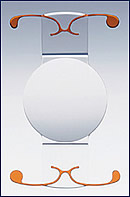 The Crystalens IOL is engineered with a hinge design to allow the optic (the part of the lens that you see through) to move back and forth as you change your focus on an image. Thus Crystalens moves and changes position using the eye’s natural focusing mechanism, instead of remaining fixed and stationary with the eye. This movement allows the eye to focus on objects across a broad range of distances to reduce or eliminate dependence on glasses. In particular, this accommodation provides significant advantages in improving intermediate vision.
Generally patients report that there is little adjustment required for the Crystalens lens implant. Crystalens produces a single image, consistent with normal vision, meaning patients do not need to adapt to viewing multiple images. In addition, patients with Crystalens implants report fewer problems with glare, halos and night vision. Nonetheless, as with any surgical procedures, inherent risks exists with all multifocal implants, whether Crystalens or ReSTOR, and a patient’s results cannot be guaranteed.
Toric Lenses – Toric
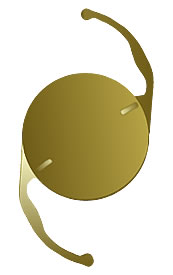 The Acrysof Toric lens implant differs from the multifocal implants describe above in that it was specifically designed for patients who have a significant amount of astigmatism. In the past, when patients with significiant astigmatism had cataract surgery, they would still require glasses for near and distance vision (because of their astigmatism). The design of the Acrysof Toric lens makes it possible to reduce or eliminate astigmatism and improve uncorrected distance vision. As with the other premium multifocal implants described above, there is an additional cost for this lens implant. However, we strive to make all of these lenses affordable through our various payment options.
ZEISS multifocal IOLs
Prior to your cataract surgery, you and your doctor will discuss which IOL is best for your vision needs. Your doctor may recommend a ZEISS multifocal IOL. ZEISS is a trusted brand in optics, and is well known for manufacturing a wide range of high quality lenses.
The AT LISA® multifocal and multifocal toric IOLs are designed to provide good distance vision and near vision for comfortable reading. When you choose a multifocal over a monofocal IOL, you open up the possibility to live your life free from glasses.
ZEISS multifocal IOLs
ZEISS AT LISA IOLs
• Provide multiple focus points
• Good image quality at a range of distances
• Correct existing refractive errors, including regular astigmatism
Clinical studies show that the AT LISA family of multifocal IOLs provides more than 90% of patients freedom from wearing glasses.
AT LISA tri – latest generation of ZEISS multifocal IOLs
The AT LISA tri, provides excellent functional vision, not only near and far, but also at intermediate distances such as when using a computer, preparing food or having a conversation. Enjoy good vision in all light conditions, even when driving at night or reading a menu in a dimly lit restaurant. This trifocal IOL from Carl Zeiss is the result of years of experience in the development of optical technology. It is designed to match your high expectations, giving you the best chance to live an active life without glasses.
As with all multifocal IOLs, after implantation of the AT LISA tri you will need some time to adjust to the new visual images. Results have shown that in addition to excellent visual acuity, patient results after surgery with AT LISA tri show fast adaptation to this new optic design with lower levels of light side effects. When you choose AT LISA tri, you are choosing the opportunity to live your life free from glasses.